Political Science 233, The Global Resurgence of Democracy Fall Term 2004
Session 2: Liberalization and Elite Pacts
I. Under what conditions is liberalization of authoritarianism possible/probable?
A. The Beginning Point for LiberalizationB. Four Mediating Factors
1) Types of Authoritarian Regimes (graphic)2) External Conditions
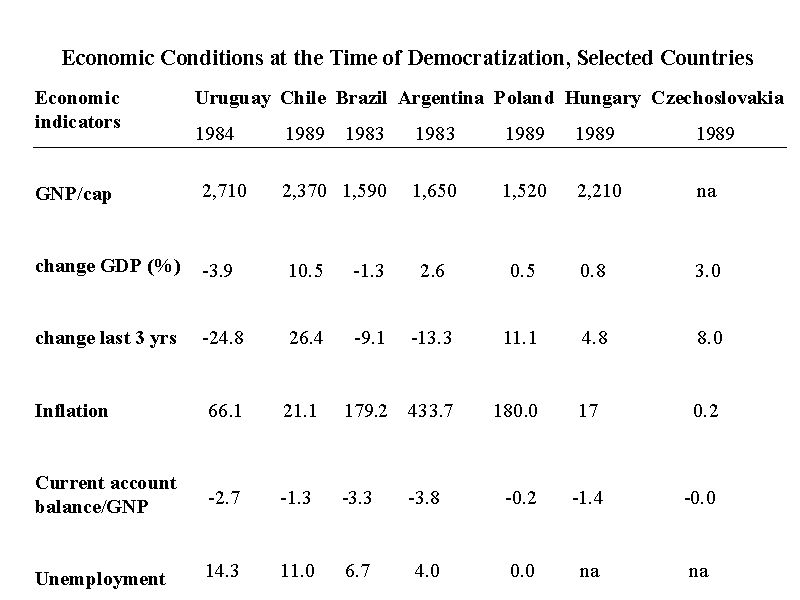
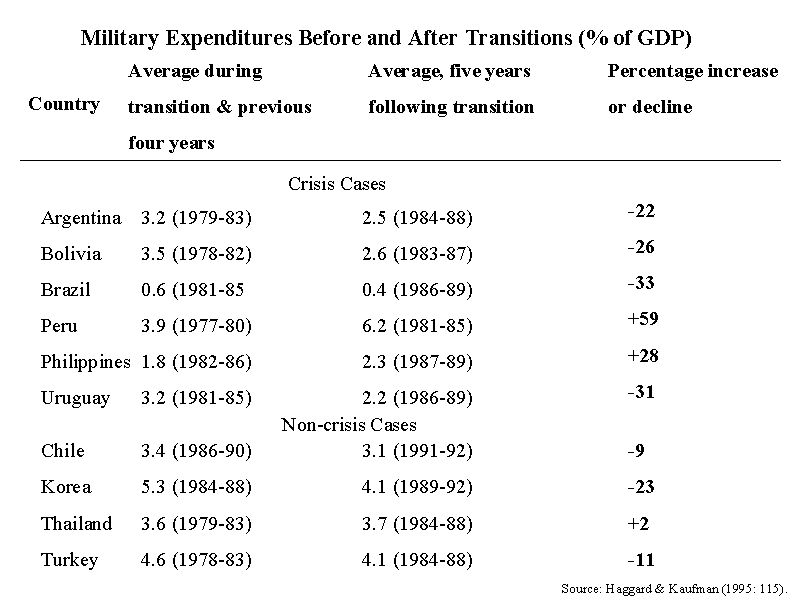
3) Economic Crisis (graphic) (graphic) (graphic)
4) Strategic Interaction (graphic)
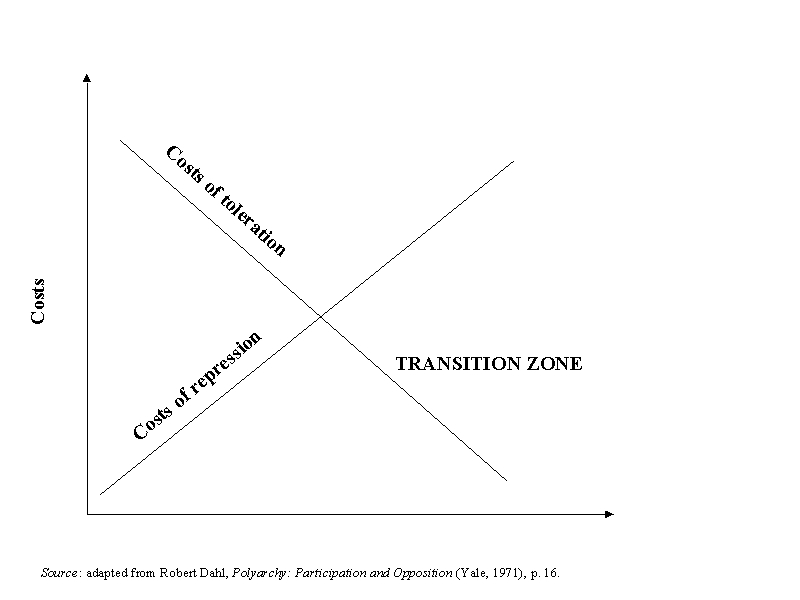
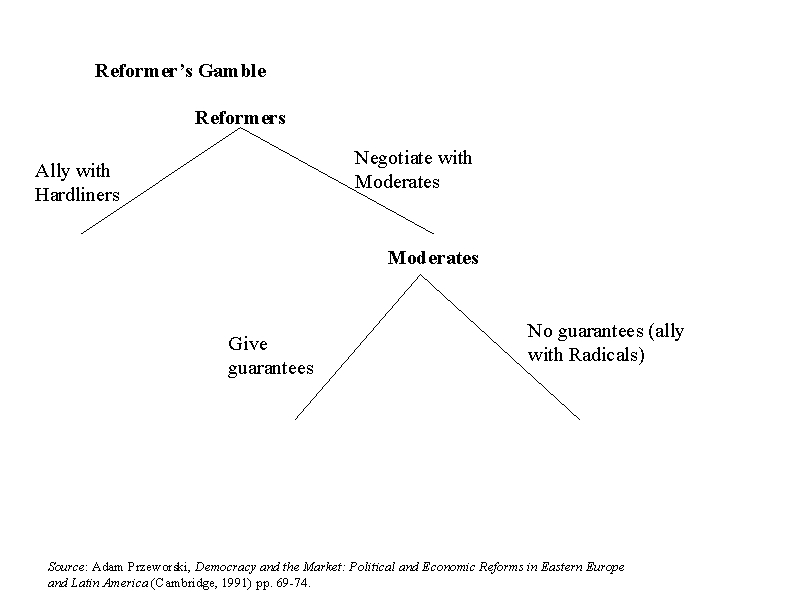
a) The Liberalizer's Gamble (graphic)b) The Reformer's Gamble (graphic)
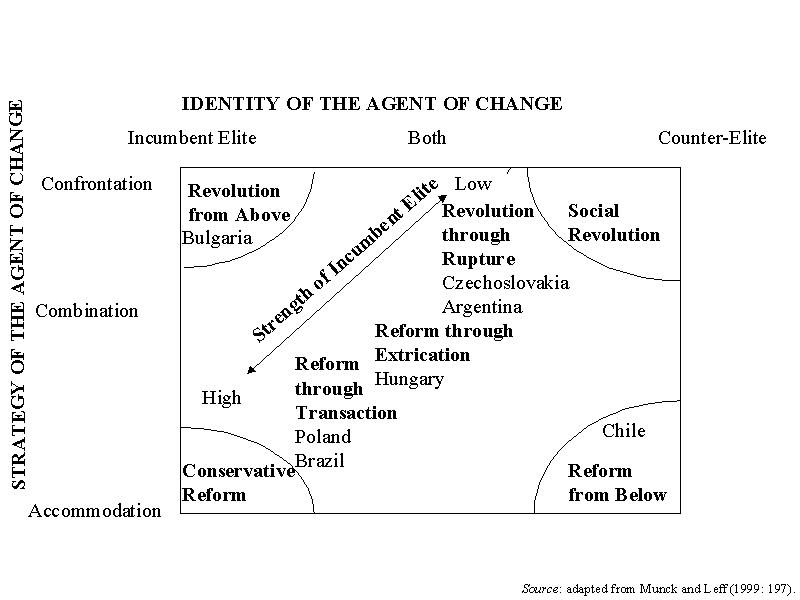
C. Modes of Transition and Democratization (graphic)
II. How can democratic elites turn liberalization into democratization?
Handouts and Links:
Floating Exam Handout
Simulation #1: The Transition Game
Key Concepts: liberalization (also: opening (apertura), decompression (distensão), renewal (odnowa), reconstruction (perestroika)), liberalization reversals, demonstration effects, Zeitgeist, problem of multicollinearity, the Lipset hypothesis, the "myth of the authoritarian advantage," Liberalizers (soft-liners), Hardliners, the costs of repression v. the costs of toleration, broadened v. status quo v. narrowed dictatorships, transition, pacts, consociationalism, Reformers, Moderates, Radicals, "democracy with guarantees" v. "democracy without guarantees," contingent consent, bounded uncertainty.
Key Individuals: Seymour Martin Lipset, José María Maravall, Guillermo O'Donnell, Philippe Schmitter, Adam Przeworski.
Study Questions:
(September 28, Tuesday)
What are the “preparatory” conditions that make transitions to democracy possible? Be sure that you understand at least three of these.
Under what conditions is the liberalization of authoritarianism possible? List three and be prepared to discuss their effects on the possibilities for transition, including how these conditions might develop in ways that reverse the transition.
How does the type of nondemocratic regime affect the kind of transition that can occur? Select two nonauthoritarian types and prepare to discuss similarities and differences in their effects on transition possibilities.
How do actor capacities and strategies affect the prospects for transition? Focus on any one of the key transition actors and explain how capacities and strategies may vary in ways that have distinct implications for transition outcomes.
(September 30, Thursday)
Are there strategies in pact-making that are more conducive to a successful transition than other possible strategies? Specify two major strategies and their probable outcomes. Be sure to use the Spanish case to substantiate your views.
Munck and Leff argue that “the process of transition itself is important in determining the likelihood that the outcome of transition will be a democratic form of government...” How do “modes of transition” affect the outcome? Be sure to compare at least two different types of “modes of transition” to support your answer.
Floating Comprehensive Exam Questions: Answer One (Due Monday, October 11)
(A) Compare two empirical cases of transition. What key similarities and differences explain the outcomes of transition?
(B) How do the “modes” and strategies of transition actors affect the outcome? Identify two major factors that differentiate “successful” from “unsuccessful” cases of transition. Illustrate how these factors work in comparative perspective (use at least two empirical country cases of transition to support your answer).
Note: If you choose not to answer one of these questions, you will have two more sets of exam questions to satisfy the one question requirement during sessions 2-4. Difficulty level increases with each set.