Political Science 233, The Global Resurgence of Democracy Fall Term 2004
Session 5: Institutional Design: Presidentialism/Parliamentarism and Electoral Systems
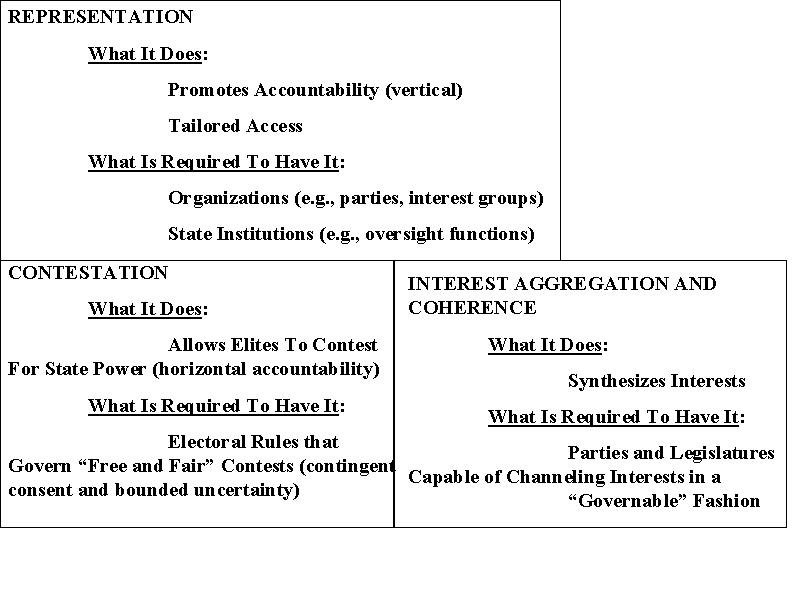
I. The Functions of Democratic Institutions (graphic)
A. RepresentationB. Contestation
C. Interest Aggregation & Coherence
D. Efficiency, Identifiability, and Flexibility
II. Main Types and Crucial Issues
A. Electoral Systems1) Majority/Plurality Models vs. Proportional Representation Models2) Main Attributes (graphic)
B. Presidentialism v. Parliamentarism
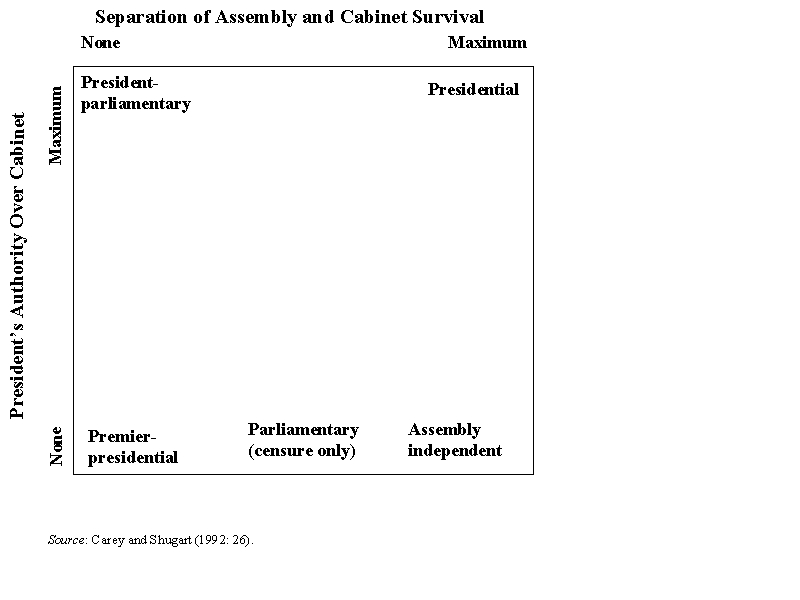
1) General Comparisons2) Cabinet Structures (graphic)
3) Patterns of Executive-Legislative Relations
C. Political Party Systems (graphic)
D. Intergovernmental Relations
1) Unitary Systems2) Federal/Decentralized Systems
a) Implications for Democracy (graphic)b) Implications for the Efficiency of Public Policy (graphic) (graphic)
III. Constructing Democracy By Choosing the Right Institutions
Small Group SimulationPhase 1: DeliberationPhase 2: Presentation
Phase 3: Defense and Elimination
Final Round (Random Selection of Cases)
IV. Elite Accountability (Discussion Questions)
A. Horizontal and Vertical AccountabilityB. Accountability-Enhancing Reforms
Handouts and Links:
Simulation #2: Constructing Democracy By Design
Paper #2
Key Concepts: political accountability, governability, interest aggregation, "winner-take-all", first-past-the-post (plurality system), single-member districts, majority run-off and majority plurality, closed/open/partially open proportional representation, mixed member proportional (personalized proportional representation), parallel-plurality PR, single transferable vote (STV), single non-transferable voter (SNTV), district magnitude, Maurice Duverger's Law and Duverger's Hypothesis, minimum thresholds, divisor/quota systems, the coattails effect, collegial and non-collegial executives, retrospective vs prospective voting, hyperpresidentialism, executive-legislative gridlock, semi-presidential or premier-presidential systems, the problem of incessant elections, unitary systems, federalism, symmetrical vs asymmetrical federalism, "coming-together" vs "holding-together" vs "putting-together" federalism, demos-contraining vs demos-enabling federalism, veto points, territorial principles in upper house composition, fiscal decentralization, "race to the bottom," tax-benefit link, horizontal and vertical accountability.
Study Questions:
(Tuesday, October 19)
What is the trade-off between "efficiency" and "representativeness"? Which presidential/parliamentary democratic regime types maximize and minimize this trade-off?
Given Carey and Shugart's defense of presidentialism and Linz' attack on it, which side persuades you more? List the three arguments that you find most persuasive.
Are the legislative powers of presidents undemocratic? Specify the institutional conditions under which these powers may be undemocratic. Under what conditions would these powers enhance democracy?
(Thursday, October 21)
Under what institutional conditions can a party system overcome "parochialism"? List the three most important conditions.
What is the relationship between party and presidential strength?
How do electoral laws affect the effective number of parties? Be sure to specify which electoral institutions most limit the number of parties and which ones tend to proliferate the number of parties.
(Tuesday, October 26)
Does institutional design matter for the "consolidation" of democracy? Support your answer with references to three empirical cases.