POSC 170
International Relations and World Politics
Spring 2003
Carleton College, Leighton 305
M-W 12:30-1:40, F 1:10 -2:10
Professor Greg Marfleet
Willis 404
Home: 645-4035
Office: 646-4116
E-mail: gmarflee@carleton.edu
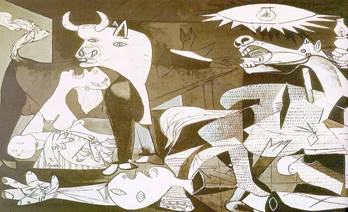
[Guernica, Pablo Picasso. Considered modern art’s most powerful anti-war statement, a tapestry version of this work adorns the chamber of the UN Security Council. It was conspicuously concealed during the most recent debates regarding war with Iraq.]
The demise of the Soviet Union marked the end the bipolar power structure that had dominated international politics—and stood as the focus of much of international relations scholarship—for 40 years. The decade that followed witnessed a sharp increase then subsidence in ethnic conflict, the emergence of the United States as seemingly unrivaled hegemon, an extraordinary economic expansion and push toward globalization, and the increasing importance of trans-national issues such as the global environment, migration, technology and health. Events fueled a debate among scholars over which approaches to understanding and explaining global politics were most useful in this new era. The debate was far resolved when the attacks of September 11th, 2001 occurred. Since then we have witnessed two unusual wars—the first against the quasi-state of Taliban-ruled Afghanistan and the second a preventative, regime-change-centered war in Iraq (which currently rages). Already in flux, international relations scholarship now stands at a crossroads. What are the important issues of this nascent century? How useful are our existing theories for understanding current issues and events? How radically must we rethink key concepts in global politics such as war, power, security, deterrence, sovereignty, interdependence and imperialism? Will states be supplanted as the primary actors by trans-national agents or supra-national entities? How useful are our existing international institutions for promoting peace, cooperation and prosperity?
This course is a broad introductory survey that is designed to acquaint students with theories, concepts and events of world politics. During the course students will gain some familiarity with the major sub-fields of international relations including security studies, foreign policy analysis, and political economy. We will also examine some current trends and issues that make the times we live in so “interesting” (alluding to that old—likely misattributed—Chinese curse) and try to assess which theories generates the best understanding the post-9/11 world. The background provided by this course should prepare students for (or perhaps entice them into pursing) future coursework in these areas or, failing that, simply make them more attentive to international events and better consumers of world news.
Course Materials to Purchase
Text and Readers
Goldstein, J.S. (2002) International Relations: Brief Edition. New York: Longman.
Purkitt, H.E. (Ed) (2002) Annual Editions: World Politics 02/03. Guilford, CT: McGraw-Hill Dushkin.
Vasquez, J. (1996) Classics of International Relations. 3rd Ed. Upper Saddle River, NJ: Prentice Hall.
Cases:
Clancy, M. (2000) Sweating the Swoosh: The Globalization of Sneakers and the Question of Sweatshop Labor. Washington D.C.: Institute for the Study of Diplomacy.
Diamond, H. (1996) The One-Hundred Hours War. Washington D.C.: Institute for the Study of Diplomacy.
Herzing, M and Skidmore, D. (1995) Nations: A Simulation Game in International Politics. Washington D.C.: Institute for the Study of Diplomacy.
Leonard, E. (2002) Establishing and International Criminal Court: The Emergence of a New Global Authority? Washington D.C.: Institute for the Study of Diplomacy.
Mistry, D. (2000) India’s Nuclear Test: The Consequences for International Security. Washington D.C.: Institute for the Study of Diplomacy.
Other Materials:
Some of the readings are freely available on-line in full text form.
Benjamin Barber’s “Jihad vs. McWorld” The Atlantic Monthly (March 1992) Vol. 269, No. 3. pp. 53-65 is available at: http://www.theatlantic.com/politics/foreign/barberf.htm
Samuel Huntington’s “The Clash of Civilizations” Foreign Affairs. (Summer 1993) Vol. 72, No. 3, pp. 22- 50. is available at:
http://www.alamut.com/subj/economics/misc/clash.html or
A substantial portion of the additional readings which are listed in the outline are available on-line in full text from through JSTOR at:
http://www.jstor.org/cgi-bin/jstor/gensearch
This is a very useful resource to which our library subscribes. It is available via the on-campus network or by using the Carleton proxy for any off campus individuals. Readings available through this service are indicated by the (J) symbol following the article citation information. You can find a reading by looking up the author and a few title key words. Readings not available through JSTOR are on reserve in Gould Library (L). I have tried to minimize these for your convenience and will not place paper copies of on-line content on reserve. You will need to search through J-Stor for articles relevant to your short paper topic.
One additional Resource that you will need to consult when you prepare your Case Study response is Lexis-Nexis a full-text, on-line news archive to which our library subscribes.
http://www.lexisnexis.com/universe
Course Requirements and Grading Options
Requirement Points
Grade Option A
Participation (‘quick responses’) 200
Case Study Response 150
Movie Review 50
Short Paper 300
Final Exam 300
Grade Option C
Participation (‘quick responses’) 200
Movie Review 50
Major Paper 450
Final Exam 300
____
1000
Points to Grade conversion: A 940+, A- 939 to 900, B+ 899 to 870, B 869 to 830, B- 829 to 800, C+ 799 to 770, C 769 to 730, C- 729 to 700, D + 699 to 670, D 669 to 630, D- 629 to 600, F 599 or less.
Description of Components
Participation: Fridays throughout the semester will be devoted to the analysis of either the current issues articles in the World Politics reader or to the relevant case study. There will be no lecture on these days. Students will be expected to have completed the readings and be prepared to generate course content that day through their informed discussion. As part of your participation grade you will be asked to write in-class ‘quick response’ 5-minute essays of not more than one, lined notepad page at the beginning of each Friday session. These essays will be collected but not graded. Your engagement in the Nations Simulation will also be considered a participation component.
Case Study Analysis: Over the term we will read and discuss four cases. Each student must submit ONE Case Study Analysis during the term on the case of their choosing. I would warn you that leaving this assignment until the last case will make for a hectic end-of-term so select your case wisely. At least one week prior to two the case discussion days I will provide a short list of questions related to the case that will be designed to encourage students to critically integrate the theoretical concepts discussed in class with real-world events described in the case. There will be some choice regarding the questions to which you will be asked to respond. Each question will involve some degree of independent research outside the class material using an on-line news source (Lexis-Nexis). This paper of not more than 5 pages (typed, double spaced, 12pt font with reasonable margins) will be due at the beginning of class on the day of the appropriate case discussion.
Short Paper: This 5 page paper (typed, double spaced, 12 point font reasonable margins) will consist of a review of 4-5 academic articles on a topic of the student’s choosing using J-STOR to identify a viable topic and some core articles. Some examples of (but not necessarily suggestions for) possible topics include topics include: Environmental scarcity and conflict, Ethnic conflict, European integration, Refugees, Nuclear Proliferation, AIDS or other global health issues, as well as deeper research into any of the areas that we touch on in the course. A simple list of the articles you plan to review will be due on due at the beginning of class May 2nd the full paper will be due Monday May 19th at the beginning of class.
Movie Review: I have tentatively scheduled Movie Night for Thursday May 8th (probably after 7:00). The Movie will be selected by class vote from a list prepared by the instructor. As this evening time will substitute for the missed class on Wednesday April 2nd, all students will expected to attend the showing (snacks will be provided as an added inducement) and play a part in our post-movie discussion. However, I am aware that some students may have scheduling conflicts. These students should feel free to rent and watch the movie at their convenience after consulting me as to the reason for their absence. Your brief (2-3 page) review of the movie (and the case) can be submitted at any time before the end of class on June 4th. I STRONGLY suggest completing it earlier however, as the end of the semester will likely be a busy time for us all. The topic of your review is open. You can address anything you found interesting about the movie and case that relates to international relations. Obviously, the best reviews will consciously refer to theoretical approaches, key concepts or other course topics and will conspicuously refer to course literature (and provide the customary citations).
Major Paper: Do you already have a particular interest that you might like to explore further within the context of this class? For students who like to work independently, a term-paper option is provided as an alternative to the case study and short paper. This research paper of roughly 15 pages (typed, double spaced 12 point font with reasonable margins) can be undertaken only with regular consultation with the instructor on topic, source selection etc. Generally, only more senior students should consider this option. The Major Paper is due by the end of class Friday June 4th no extensions until June 9th will be allowed under any circumstances.
Simulation: One week of class will be devoted to the Nations Simulation exercise. The class will be divided into 7 groups of 6 or so individuals and assigned to particular countries. Active engagement will be considered as part of the participation grade.
Final Exam: Will take place on Monday June 9 from 3:30 to 6:00 PM. The exam will be comprehensive, in-class, and closed book. It will be comprised of two sections. The first will consist of six, short-answer (identify and explain the significance of …” type) questions from which students will select and respond to three (150 points total). Each response should take-up roughly one page of an 81/2 x 11 exam booklet (up to two pages in the smaller ones). The second section will provide three questions from which you will choose one for a longer essay response (150 points)
Notice on Late Papers:
All late papers will be penalized 10 points per day (or any part of a day) to a maximum of 50% of the available points for that project. If the syllabus indicates a paper must be handed in at the beginning of class and you hand it in after class a late penalty will be applied. Notice, however, that no matter how late something is, it is ALWAYS worth submitting.
March 31 – M Introduction, Syllabus, Why Study IR?
April 2 – W No class – Time to be made up on Movie Night
April 4- F Origins of the State System to New World Order
· Goldstein Chapter 1
· World Politics reader Unit 1 “New World Order”
· [58 pages]
April 7 – M Early IR Theory: The First Great Debate Realism vs. Idealism Morality and International Politics
· Vasquez: Chapters 1, 2 and 3
· [43 pages]
April 9 – W The Second Great Debate: Traditionalists vs. Behavioralists
Levels of Analysis: The Structure, The State & The Individual
Neo-Realism and Neo-liberalism
· Goldstein Chapter 2 & 3 (84-92)
· Vasquez Chapter 4 (readings 11,12,13)
· Kenneth N. Waltz “The Origins of War in Neorealist Theory” Journal of Interdisciplinary History, Vol. 18, No. 4, (Spring, 1988), pp. 615-628. (J)
· Joseph S. Nye Neorealism and Neoliberalism (in Review Articles) World Politics, Vol. 40, No. 2. (Jan., 1988), pp. 235-251 (J)
· [101 pages]
April 11 – F WP Reader Discussion (Unit 4, North America)
April 14 – M Defining Power, the Balance of Power and Power Transitions
· Nye, Joseph S., Jr., "The Changing Nature of World Power," Political Science Quarterly, Vol. 105, No. 2. (Summer, 1990), pp. 177-192 (J)
· Vasquez Chapter 10
· [31 pages]
April 16 – W Arms and Allies and the Proliferation of WoMD
· Scott D. Sagan, “Why Do States Build Nuclear Weapons? Three Models in Search of a Bomb (in A Boom of One's Own)” International Security, Vol. 21, No. 3. (Winter, 1996-1997), pp. 54-86 (J)
· World Politics Reader Unit 3 MoMD
· [53 pages]
April 18 – F Case Study: India’s Nuclear Tests
April 21 – M Deterrence, Compellance and War
· Goldstein Chapter 4
· Vasquez Chapter 8 and Chapter 11
· [132 pages]
April 23 – W Critiques of the Structural Approach
The Third Great Debate?: Constructivism
· Goldstein Chapter 3 (115 -136)
· Alexander Wendt, “Constructing International Politics” International Security, Vol. 20, No. 1. (1995), pp. 71-81 (J)
· Vasquez Chapter 4 (14 and 15) and Chapter 5
· [ 70 pages]
April 25 – F WP Reader Discussion (Unit 8 Pacific Basin)
April 28 – M The Democratic Peace
· Vasquez Chapter 13
· Goldstein Chapter 3 (95-112)
· [49 pages]
April 30 – W Domestic Politics I: Organizational and Bureaucratic factors
· Vasquez Chapter 6
· [50 pages]
May 2 – F Case Study: The 100 Hours War
May 5 – M [NO CLASS MIDTERM BREAK]
May 7 – W Domestic Politics II: Decision Making and Interstate Crisis
· Vasquez Chapter 7
· Valerie M. Hudson; Christopher S. Vore “Foreign Policy Analysis Yesterday, Today, and Tomorrow (in Reflection, Evaluation, Integration)” Mershon International Studies Review, Vol. 39, No. 2. (Oct., 1995), pp. 209-238. (J)
· [ 47 pages]
May 8 TH MOVIE NIGHT; Movie TBA,
Food Provided!
May 9 – F WP Reader Discussion (Unit 6 Europe)
May 12 – M *********************
May 14 – W Nations Simulation Week
May 16 – F *********************
May 19 – M International Organization
· Vasquez Chapter 12
· Goldstein Chapter 6
· [80 pages]
May 21 – W Political Economy: Globalization and Interdependence
· Goldstein Chapter 5
· World Politics Reader Unit 2
· [84 pages]
May 23 – F Case Study: Establishing an International Criminal Court
May 26 – M Imperialism
· Vasquez Chapter 9
· World Politics Reader Unit 7
· [52 pages]
May 28 – W North South Relations
· Goldstein Chapter 7
· World Politics Reader Unit 5
· [88 pages]
May 30 – F Case Study: Sweating the Swoosh
June 2 – M Trans-National Problems, State actors and Beyond
· World Politics Reader Unit 10
· Benjamin Barber’s “Jihad vs. McWorld” The Atlantic Monthly (March 1992) Vol. 269, No. 3. pp. 53-65 [see link]
· Samuel Huntington’s “The Clash of Civilizations” Foreign Affairs (Summer 1993) Vol. 72, No. 3, pp. 22- 50 [see link]
·
[40 pages]
June 4 – W WP Reader Discussion (Unit 9 Middle East and Africa)
June 9 - M FINAL EXAM 3:30 to 6:00