Political Science 233, The Global Resurgence of Democracy Fall Term 2004
Session 4: Civil-Military Relations
I. Critical Perspectives on the Concept of "Consolidation"
A. Linz & Stepan's Approach (graphic)B. Problems with the Concept
1) Tautological Reasoning2) The Degree Problem
3) The Time-Frame Problem
4) The Teleology Problem
5) The Political Learning Problem
II. Can Formerly Putchist Militaries Be Made To Accept Democracy?
A. What Does the Military Want From Politics?1) Some Theories (graphic)2) Stepan's Institutionalist Theory
B. The Key Issues for the Military After Transition
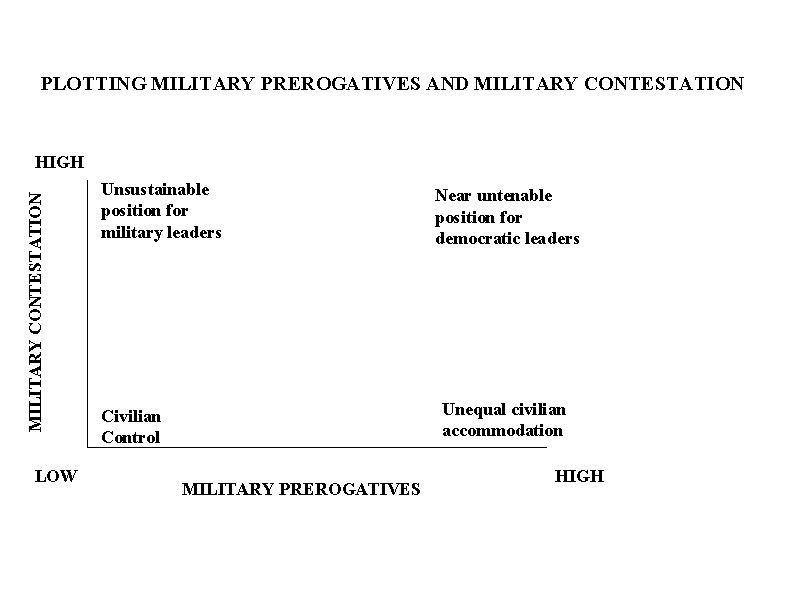
1) Restoring the Professional Mission of the Military (graphic)2) The Problem of Military Prerogatives ("Reserved Domains") (graphic)
3) Why the Military Lost Influence in Some Countries
Handouts and Links:
Floating Exam Handout
Debate#2: Justice or Peace: Should the generals be put on trial?
Key Concepts: the three dimensions of democratic consolidation; tautology; teleology and telos in consolidation; "learning by doing"; the military-as-government and the military-as-institution; the "Bonapartist moment"; the "new professionalism"; military prerogatives; reserve domains (authoritarian enclaves); ministerial control (civilian control); the military's strategic resources; the organizational mission; "return to the barracks"; the threat of revanchismo; military contestation.
Study Questions:
(October 12, Tuesday)
Is the concept of "democratic consolidation" useful? List three reasons why it is and three reasons why it might not be. Be prepared to discuss these in class.
Under what conditions can civilians exert "ministerial control" over the armed forces in cases of post-military authoritarian regimes? List and discuss three conditions. Be prepared to discuss these with reference to the South American and Southeast Asian cases.
(October 14, Thursday)
Why is the creation of a "culture of fear" so important to authoritarian regimes? List the two top reasons.
How can segments of civil society overcome a culture of fear? Specify the kind of actors that are likely to resist a culture of fear and then indicate which strategies are likely to be successful.
Is fear a transitory "echo" of the authoritarian period, a phenomenon that is likely to pass with time, or is it a persistent problem for new democracies that is unlikely to simply "go away?"
Floating Comprehensive Exam Questions: Answer One (Due Tuesday, October 26)
(A) Select three cases of transition from military authoritarianism from the set of “third wave” (post-1974) cases that we have studied. Highlight the aspects of these cases that confirm and those that disconfirm (or raise questions about) the usefulness of Stepan’s theory that the military's professional mission should be the focus of analysis.
(B) Discuss under what conditions civil society is in a position to overcome a “culture of fear” in post-authoritarian cases. Be sure to (a) specify an argument focusing on key variables and (b) use at least three empirical cases to support your position.
Note: You must answer one of these questions if you have not answered an exam question to date.